
Credits and Licenses
The acknowledgments the licenses ask for, the data DSPX uses, and the software it is made with
DSPX is made with the work of many others, and uses data that astronomers and space agencies make freely available. This chapter gives the acknowledgments that the licenses of that software and those data ask us to print, in their own words, says where the sky catalogs and surveys come from, and lists the third-party software DSPX is made with, with its license and the file that holds the license text.
19.1Acknowledgments
DSPX is copyright © 2026 Rogelio Bernal Andreo, Deep Sky Colors. All rights reserved.
19.1.1The PixInsight Class Library
Parts of DSPX's image engine, of its pre-processing engine and of its astrometry are derived from the PixInsight Class Library, which is licensed under the PixInsight Class Library License 2.0. The License asks for this acknowledgment, which we give here in its words:
This product is based on software from the PixInsight project, developed by Pleiades Astrophoto and its contributors (https://pixinsight.com/).
The License's notice, its conditions and its disclaimer are in the file PCL-LICENSE.txt in the licenses folder next to the
program. The names of the PixInsight project and of Pleiades Astrophoto are not used to endorse or promote DSPX.
19.1.2Other acknowledgments
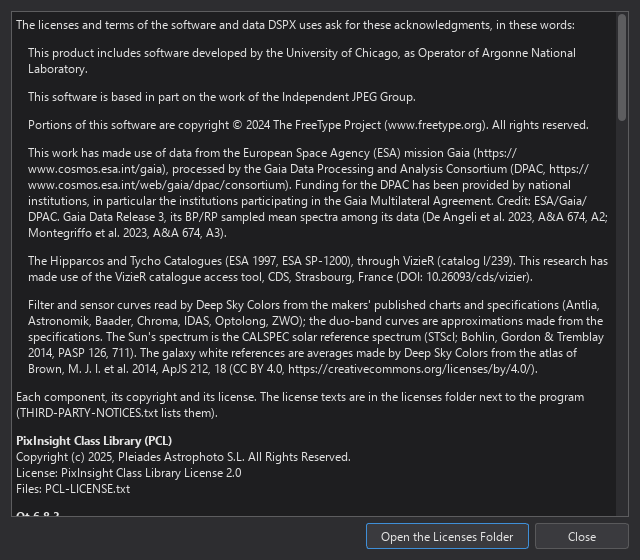
These licenses ask for a notice of their own, which is also printed in the About box's Licenses... dialog:
- Minpack (the C/C++ port, cminpack): This product includes software developed by the University of Chicago, as Operator of Argonne National Laboratory.
- The Independent JPEG Group's JPEG software: This software is based in part on the work of the Independent JPEG Group.
- FreeType, used inside Qt: Portions of this software are copyright © 2024 The FreeType Project (www.freetype.org). All rights reserved.
The data DSPX uses have acknowledgments too; they are in the next section.
19.1.3The release name
This release of DSPX is named Leavitt, after Henrietta Swan Leavitt (1868–1921), the American astronomer at the Harvard College Observatory. While measuring the brightness of thousands of variable stars in the Magellanic Clouds, she found that the period of a Cepheid variable star's pulsation is tied to its true luminosity. That relation became the yardstick for measuring the distances to the galaxies beyond our own, and it is the basis of the discovery that the universe is expanding. DSPX is named in honor of her work.
The name carries a personal note as well: Leavitt Falls in California, under a very dark sky, is a place that is deeply special to me, and a part of why this release is called Leavitt.
19.1.4Where to find them in the program
The box has a Licenses... button. The dialog it opens prints the
acknowledgments above except the PixInsight Class Library's (that one is printed here), then every component with its copyright, its
license and the files that hold the license text, and a Open the Licenses Folder button. The same credits are in
THIRD-PARTY-NOTICES.txt, the index of the licenses folder.
19.1.5Siril
DSPX runs Python scripts written for Siril, and speaks the protocol of Siril's Python library, sirilpy (Scripts and Python). DSPX is not affiliated with or endorsed by the Siril project. The scripts are their authors' work, not Deep Sky Colors'.
19.2Catalogs and Surveys
The processes that need the sky read star catalogs and, when asked, sky surveys. Each source asks for a credit, and this is where we give it.
19.2.1Gaia
Plate Solve, Catalog Star Color, Photometric Glow Subtraction, Finding Chart and the spectrophotometric calibrations use stars from the Gaia catalog, whether they come from the catalog files, which Get Catalog Files... downloads from Deep Sky Colors' server, or from the online archive. The window shows the credit that goes with the files. The credit that goes with every file built from it is also written inside the file:
This work has made use of data from the European Space Agency (ESA) mission Gaia (https://www.cosmos.esa.int/gaia), processed by the Gaia Data Processing and Analysis Consortium (DPAC, https://www.cosmos.esa.int/web/gaia/dpac/consortium). Funding for the DPAC has been provided by national institutions, in particular the institutions participating in the Gaia Multilateral Agreement. Credit: ESA/Gaia/DPAC. Gaia Data Release 3, its BP/RP sampled mean spectra among its data (De Angeli et al. 2023, A&A 674, A2; Montegriffo et al. 2023, A&A 674, A3).
19.2.2Hipparcos and Tycho
The brightest stars come from the Hipparcos and Tycho Catalogs, through VizieR. Their credit, in its words:
The Hipparcos and Tycho Catalogues (ESA 1997, ESA SP-1200), through VizieR (catalog I/239). This research has made use of the VizieR catalogue access tool, CDS, Strasbourg, France (DOI: 10.26093/cds/vizier).
19.2.3Surveys, object names and CDS
Survey Overlay fetches cutouts of sky surveys from the hips2fits service of the Centre de Données astronomiques de Strasbourg (CDS), and Plate Solve asks the SIMBAD database, also operated by CDS, for the position of an object name that its own list does not have. The surveys are published by their own teams, each with its own terms; the survey's copyright notice is written to the Log whenever a cutout is fetched, and belongs with any picture made from it. Please credit CDS, SIMBAD, VizieR and the survey itself when publishing what these services provided.
19.2.4Sky data: names, outlines and constellations
Finding Chart and Plate Solve's object names read the sky data that ships with the program: plain text files in the folder data/sky, next to the program. Each file names its source, version, license and attribution in its first lines. They are separate data files, not part of the program, and the license of DSPX does not change their own. Their credits, in their words:
Deep-sky objects and nebula outlines: OpenNGC, credits: Mattia Verga, https://github.com/mattiaverga/OpenNGC (release v20260501), licensed under CC BY-SA 4.0 (https://creativecommons.org/licenses/by-sa/4.0/). Deep Sky Colors converted them; the converted files are licensed under CC BY-SA 4.0. OpenNGC merges data from the NASA/IPAC Extragalactic Database (NED), HyperLEDA, SIMBAD, HEASARC and Harold Corwin's NGC/IC positions and notes. This research has made use of "Aladin sky atlas" developed at CDS, Strasbourg Observatory, France.
The constellation figures and names are from Stellarium's "Modern (IAU)" sky culture (figures by Sky & Telescope, Roger Sinnott and Rick Fienberg, published by the IAU), © Stellarium's team, licensed under CC BY-SA 4.0 (https://creativecommons.org/licenses/by-sa/4.0/). Deep Sky Colors converted them to J2000 coordinates; the converted file is licensed under CC BY-SA 4.0. Source: https://github.com/Stellarium/stellarium (commit c8ec7cfa).
The constellation boundaries are those adopted by the IAU (Delporte, E. 1930, Délimitation scientifique des constellations, Cambridge University Press), from the Catalogue of Constellation Boundary Data (Davenhall & Leggett 1989; VizieR VI/49), precessed to J2000 by Deep Sky Colors; the constellation of a position from Roman, N.G. 1987, PASP 99, 695 (VizieR VI/42).
Star names: the IAU Catalog of Star Names, IAU Working Group on Star Names (WGSN), https://www.iau.org/public/themes/naming_stars/ (Creative Commons Attribution).
The figures' stars: the Bright Star Catalogue, 5th Revised Ed. (Hoffleit & Warren 1991; VizieR V/50), with the identifications of the HD-DM-GC-HR-HIP-Bayer-Flamsteed Cross Index (Kostjuk 2002; VizieR IV/27A) and of SIMBAD. Nebula catalogs: Sharpless, S. 1959, ApJS 4, 257 (VizieR VII/20); Barnard, E.E. 1927 (VizieR VII/220A); van den Bergh, S. 1966, AJ 71, 990 (VizieR VII/21), with the Henry Draper Catalogue (VizieR III/135A). This research has made use of the SIMBAD database, operated at CDS, Strasbourg, France, and of the VizieR catalogue access tool, CDS, Strasbourg, France (DOI: 10.26093/cds/vizier).
The Creative Commons Attribution-ShareAlike 4.0 license's text is in the folder licenses, next to the program (CC-BY-SA-4.0.txt).
19.2.5Spectrophotometric curves
The filter and sensor curves of Spectrophotometric Color Calibration and Spectrophotometric Flux Calibration were read by Deep Sky Colors from the published charts and specifications of their makers; the duo-band curves are approximations made from the specifications. The Sun's spectrum is the CALSPEC solar reference spectrum (STScI; Bohlin, Gordon & Tremblay 2014, PASP 126, 711). The galaxy white references are averages made by Deep Sky Colors from the atlas of Brown, M. J. I. et al. 2014, ApJS 212, 18 (CC BY 4.0).
19.3Third-Party Software
DSPX is built with the components below. Each license text is in the licenses folder next to the program, in the file named in the
last column. Qt is used unmodified and linked dynamically, so its libraries are separate files that can be replaced with another build of
the same version; LibRaw is used unmodified. DSPX also ships Qt's lrelease tool, in the tools folder next to the program:
it compiles a translation file that someone adds (Translating DSPX into Your Language).
It is part of Qt, unmodified, under the same terms as the Qt libraries.
| Component | Used for | License | License file |
|---|---|---|---|
| PixInsight Class Library | Parts of the image, pre-processing and astrometry engines | PixInsight Class Library License 2.0 | PCL-LICENSE.txt |
| Qt 6.8.3 | The window, widgets, graphics, network and image plugins | GNU Lesser General Public License v3 | Qt-LGPL-3.0.txt, Qt-GPL-3.0.txt, Qt-third-party.txt |
| FreeType 2.13.3 (in Qt) | Drawing text | FreeType Project License | FreeType-FTL.txt |
| LibRaw 0.22.3 | Reading camera raw files | CDDL 1.0 | LibRaw-COPYRIGHT.txt, LibRaw-LICENSE.CDDL.txt |
| Google Highway 1.3.0 | Vectorized computation | BSD 3-Clause | Highway-LICENSE-BSD3.txt |
| OpenCV 4.14.0 | Finding the same places in images and putting images together (Surface Align) | Apache License 2.0 | OpenCV-LICENSE.txt |
| Little CMS 2.17 | Color management | MIT | lcms2-LICENSE.txt |
| PhotoCraft (Copyright © 2026 ArtCraft Team and the PhotoCraft contributors) | The Faint Signal Lift process, built on a port of PhotoCraft's Relight filter | MIT | PhotoCraft-LICENSE.txt |
| LibTIFF 4.7.1 (its LZW code includes software developed by the University of California, Berkeley) | TIFF files | LibTIFF License | libtiff-COPYRIGHT.txt |
| IJG JPEG software 9e | JPEG files | IJG License | libjpeg-README.txt |
| zlib 1.2.13 | Compression in XISF, PNG and TIFF | zlib License | zlib-LICENSE.txt |
| LZ4 1.9.4 | Compression in XISF | BSD 2-Clause | lz4-LICENSE.txt |
| Zstandard 1.5.5 | Compression in XISF | BSD 3-Clause | zstd-LICENSE.txt |
| cminpack | Non-linear least-squares fitting | Minpack License | cminpack-CopyrightMINPACK.txt |
| ONNX Runtime | Running the AI processes' networks | MIT, with its third-party notices | ONNXRuntime-LICENSE.txt, ONNXRuntime-ThirdPartyNotices.txt |
| ONNX Runtime WebGPU provider, with Dawn (Linux) | Running the networks on a discrete graphics card | MIT, with its third-party notices | ONNXRuntime-WebGPU-LICENSE.txt, ONNXRuntime-WebGPU-ThirdPartyNotices.txt |
| DirectML (Windows) | Running the networks on the graphics card | Microsoft Software License Terms | DirectML-LICENSE.txt |
| volk 1.4.341 | Loading the graphics driver's Vulkan library, for the steps that run on the graphics card | MIT License | volk-LICENSE.txt |
| Vulkan Memory Allocator 3.3.0 | Managing the graphics card's memory for those steps | MIT License | VMA-LICENSE.txt |
| Vulkan-Headers 1.4.341 | Talking to Vulkan | Apache License 2.0 | VulkanHeaders-LICENSE.txt |
| MoltenVK 1.4.2 (macOS) | Vulkan on a Mac's graphics chip, on top of Metal | Apache License 2.0 | MoltenVK-LICENSE.txt |
| Skin textures of the built-in themes (Poly Haven, ambientCG) | The pictures of the DSPX Granite theme's skins, and Copper's rust skin | Public domain (CC0 1.0) | SKINS-TEXTURES.txt |
| Skins and wallpapers of the built-in themes made for DSPX | The tiles and wallpapers of the Copper to Minimalist themes, except Copper's rust texture | Part of DSPX (no third-party picture) | SKINS-TEXTURES.txt |
ONNX Runtime's, DirectML's and the WebGPU provider's files are also kept in the folder with their libraries (bin), as the runtime delivers them.
On macOS the licenses folder is in the application's resources.
The Python that runs Siril's scripts is not part of DSPX: DSPX downloads a pinned Python after asking (Setting Up Python), and the scripts are their authors' work, under their own licenses.
GraXpert is not part of DSPX either. It is a separate program by its own authors, which we install ourselves and which the GraXpert processes run (GraXpert). Its code is under the GNU General Public License v3, and the AI models it uses are under the Creative Commons Attribution-NonCommercial-ShareAlike 4.0 license, for non-commercial use. DSPX ships neither the program nor its models and never downloads them; its processes launch the installed program as a separate program and read its result from a file.
StarNet2 is not part of DSPX either. It is a separate program by Mikita Misiura (starnetastro.com), under its own terms, which we read in the program's LICENSE.txt. DSPX does not include or redistribute it. Its process runs the program we installed, or the copy that DSPX downloads from StarNet's own server after we ask and say yes (StarNet2), as a separate program, and reads its result from a file.